
FWD Trucks 1910-1974 Photo Archive
FWD Trucks 1910-1974 Photo Archive
ITEM E332
By Robert Gabrick
Established in 1910, The Four Wheel Drive Auto Company was created to produce automobiles. “The Battleship,” America’s “first successful four-wheel-drive automobile” was offered for sale in the company’s 1911 sales catalog. However, the start of World War I in 1914 and the unsuccessful expedition to Mexico to capture Pancho Villa in 1916 led to a change and the production of over 24,000 FWD Model B trucks.
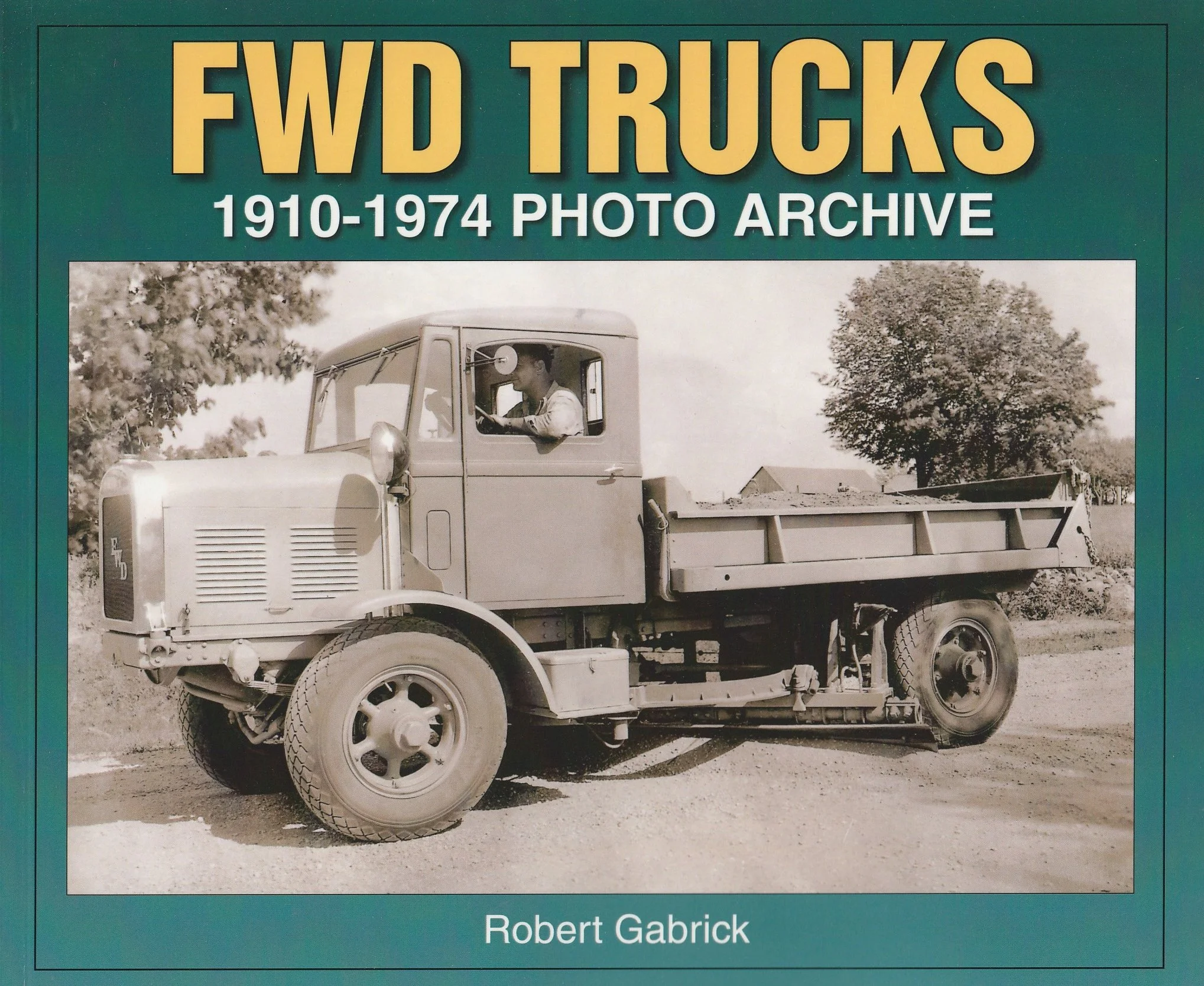
Over the years, FWD produced a variety of specialized vehicles for road construction and maintenance, snow removal, utility construction and maintenance, oil exploration and production, cement mixers, logging, and even school buses. All of these are featured here in sharp black and white photos with in-depth captions.
Softbound, 10.25”x8.5”, 128 pages, 123 photos
In my appearance in the History Channel documentary film Truck Wars: The Birth of 4WD, I declared, “I can’t imagine—and I bet you can’t, either—a world without four-wheel drive.” That assertion reflects the legacy of The Badger Four Wheel Drive Auto Co. founders Otto Zachow and William Besserdich, blacksmith-
machinists from Clintonville, Wisconsin. In 1906, they developed and patented a ball-and-socket steering joint that allowed a vehicle’s front wheels to both steer and be powered. My book uses 122 black-and-white photographs to tell the story of FWD, which was established to produce passenger cars but became known for its heavy-duty commercial vehicles. In a departure from the earliest Iconografix Photo Archive Series editions, the book features lengthy in-depth captions that provide specification details, sales literature pronouncements, and the historical context for each featured vehicle. The chronologically arranged account includes the earliest efforts to develop automobiles, the marvelous array of vehicles developed over the years for military service, and machines built for road construction and maintenance, oil field service, snow plowing, logging, and utility work. Coverage also includes FWD’s six Indianapolis 500 entries, the unusual Teracruzer (designed to transport and launch guided missiles), mobile cranes, school buses, and vehicles with four-wheel steering.
Book Review by Robert Gabrick


